
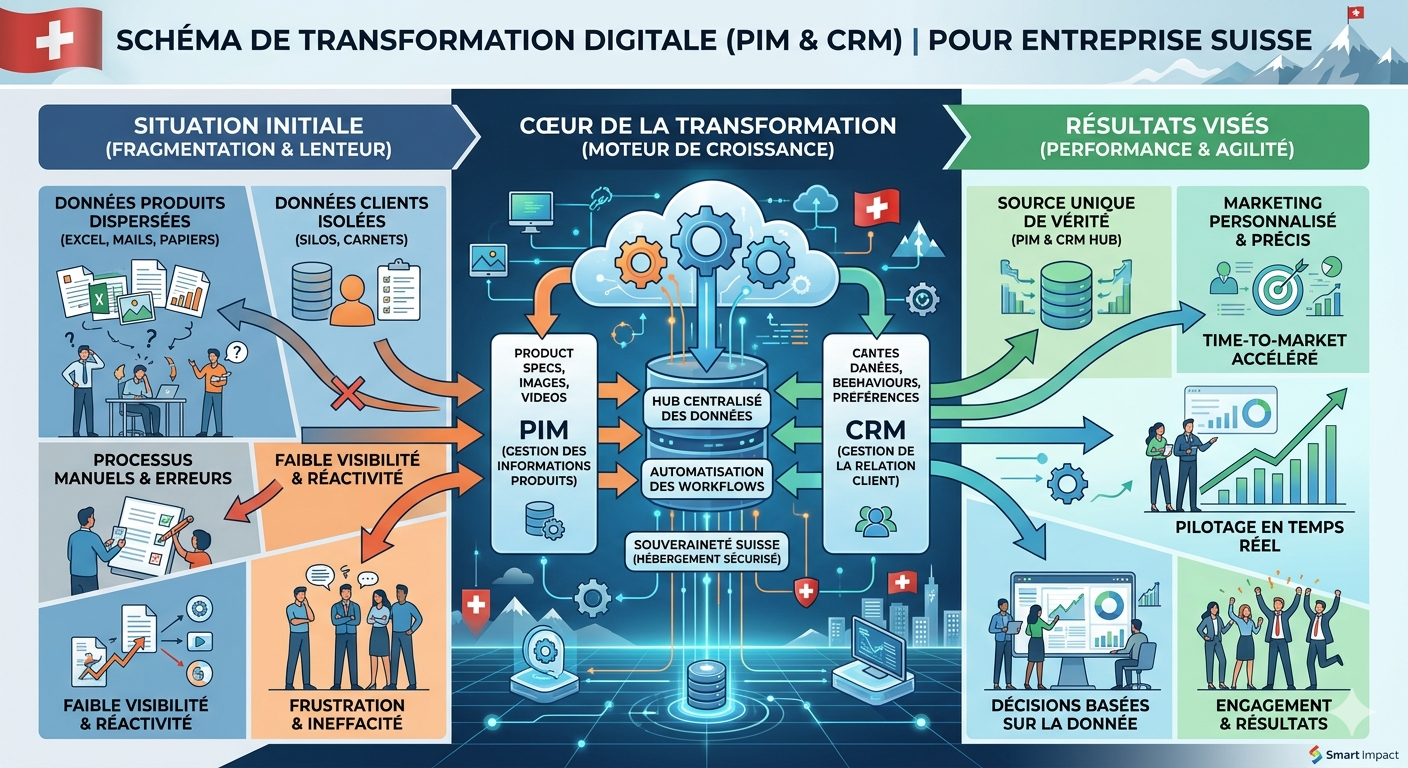

It's Friday, 5:30 pm. Your marketing team is about to launch a new campaign for the French Swiss market. Suddenly, doubt creeps in. Is the price on the data sheet right? Is this the final version of the high-definition visual? A frantic hunt ensues between e-mails, shared folders and Slack messages.
For many company managers, this “friction” is considered part of the job. They hesitate to invest in a new CRM (Customer Relationship Management) or a PIM (Product Information Management) for fear of breaking already fragile productivity or facing massive internal resistance.
And yet, the real danger is there: every minute spent by your marketing talents “cleaning” Excel files or tracking down missing information is a minute stolen from your growth.
In 2026, hesitation is no longer a prudent option, it's a tax on your competitiveness. Switching to these tools is not a software upgrade. It's a strategic re-education. It's about transforming your concierges of data at growth drivers.
PIM: from catalog hell to the Content Factory«
Visit PIM (Product Information Management) is often perceived as a mere technical library. This is a fundamental mistake. For marketing, relearning to work with a PIM means moving from manual craftsmanship to precision industry.
1. The end of the informative «Witch Hunt
Before PIM, product information was scattered: the R&D department had the specifications, sales had the discounted prices, and marketing tried to fit it all into a brochure.
- The change : the PIM becomes the “Single Source of Truth”. Your teams won't search more information, they’operate.
2. From technical description to emotional branding
The biggest difficulty for a marketing team new to PIM is letting go of technical input.
- The new mission : since technical data (dimensions, weights, materials) are centralized and automated, marketing must relearn its true added value: tell a story.
- Impact: Instead of filling in boxes, your employees create shopping experiences. They optimize SEO for French-speaking Switzerland, adapt messages for the international market, and take care of the brand image.
3. Time-to-Market: your new gearshift
In an economy where speed is of the essence, the PIM transforms your marketing into a "one-stop shop". Content Factory.
- Before : three weeks to release a catalog or update an e-commerce site.
- After : just a few clicks to distribute consistent information across all your channels (Web, Print, Marketplaces).
The executive analogy: Imagine you ask your workers to build a house, but they have to make each brick by hand before laying them. PIM means ready-to-use bricks on the building site. The house goes up faster, and it's stronger.
| Performance Indicator | Previously : The hell of Excel and Silos | After : The Power of PIM & CRM |
| Speed to market | 3 to 6 weeks (information gathering, corrections, validation). | 48 hours (data ready and synchronized on all channels). |
| Data reliability | High error rate (obsolete prices, visuals not up to date). | 100% reliability (Single source of truth). |
| Customer Experience | “Spray & Pray”: Generic messages sent to everyone. | Hyper-customization The right product at the right time. |
| Productivity Team | 40% of time spent entering and cleaning files. | 90% of time dedicated to strategy and value creation. |
| Troop morale | Frustration, feeling of doing “robot work”. | Commitment Your talents are finally doing the job they were hired to do. |
| Executive visibility | Sight-seeing steering (fragmented and often late data). | Real-time dashboard Decisions based on fresh data. |
READ : ERP & PIM: how can these systems transform (and save) your corporate culture?
CRM: from address book to crystal ball«
If the PIM manages what you sell, the CRM (Customer Relationship Management) manages which you sell it. For a marketing team, relearning CRM in 2026 means moving from administrative “policing” to needs “prediction”.
1. The end of harassment marketing
Old-fashioned marketing is bombarding your database in the hope that someone will take the bait. It's ineffective, and it damages your brand image in Switzerland, where discretion and relevance are king.
The change : CRM enables you to segment your customers according to their actual behavior.
The new skill : your teams need to relearn’empathy at scale. Instead of writing a newsletter for 10,000 people, they set up workflows that are activated when a customer expresses a specific need.
2. Marketing becomes sales' best ally
The historical conflict between Marketing and Sales ends where CRM begins.
The modern approach: marketing no longer gives “lists of names” to salespeople, but rather mature opportunities. Thanks to CRM, marketing knows exactly when a prospect is ready to be called, because it has followed his or her entire digital journey.
3. Anticipate rather than react
A modern CRM, coupled with a dose of AI, doesn't just tell you what happened last month. It tells you what's likely to happen next month.
Transition : your marketing team moves from a “reporting” role (looking in the rear-view mirror) to a role of “forecast” (looking through the windshield). It can anticipate a drop in demand or, on the contrary, a cross-selling opportunity before the customer even thinks about it.
READ : 7 actionable SEO levers for SMEs in French-speaking Switzerland.
The leader's role in this transition: sell the destination, not the vehicle
To succeed in this change, the CEO must not become an IT expert. His role is to giving meaning to rigor.
- Don't talk about “required fields”: talk about “getting to know our customers better to serve them better”.
- Accept the “ugly middle”: Every transition has a low point, when the old system is dead and the new is not yet fluid. This is where your emotional leadership intervenes to keep us on course.
- Invest in data culture: software costing CHF 50,000 is worth nothing if your teams haven't understood that data is your company's most precious asset.
Speed is your new defense
As you can see, installing a PIM or CRM is not an expense; it's the purchase of your future agility. In the French-speaking Swiss market of 2026, the difference between the leader and the others will no longer be based on the product alone, but on the ability to bring it to market faster and more intelligently than the others.
The “relearning” of your teams is therefore a necessary investment. It's time to transform your file managers into true architects of growth.
Sources :
Gartner : reports on “Single Source of Truth” (SSOT). They explain how centralizing data reduces operational errors by 20 to 30 %.
Forrester: concept of“Total Economic Impact”(TEI). Forrester often publishes studies showing the massive ROI of CRMs (such as Salesforce or HubSpot) over 3 years.
Harvard Business Review: “Digital Transformation Is Not About Technology“ (Tabrizi et al.).
MIT Sloan Management Review: their work on“Digital Maturity”This is why “mature” companies use PIM and CRM not to store data, but to innovate.
IFPDT (Federal Data Protection Commissioner) : for all matters relating to the Data Protection Act (DPA). Indispensable for the “Sovereignty and Security” aspect of your CRM.
ICTswitzerland / Digitalswitzerland : their annual reports on Switzerland's digital maturity enable you to situate your customer in relation to local competitors.

Co-founder of Smart Impact.Passionate about the web from the outset, he launched his first project in 2006: an online music magazine that is still running today. With almost 20 years' experience in SEO, a federal diploma in marketing and a solid geek culture, he and his team transform customers' (sometimes vague) ideas into concrete digital projects.