
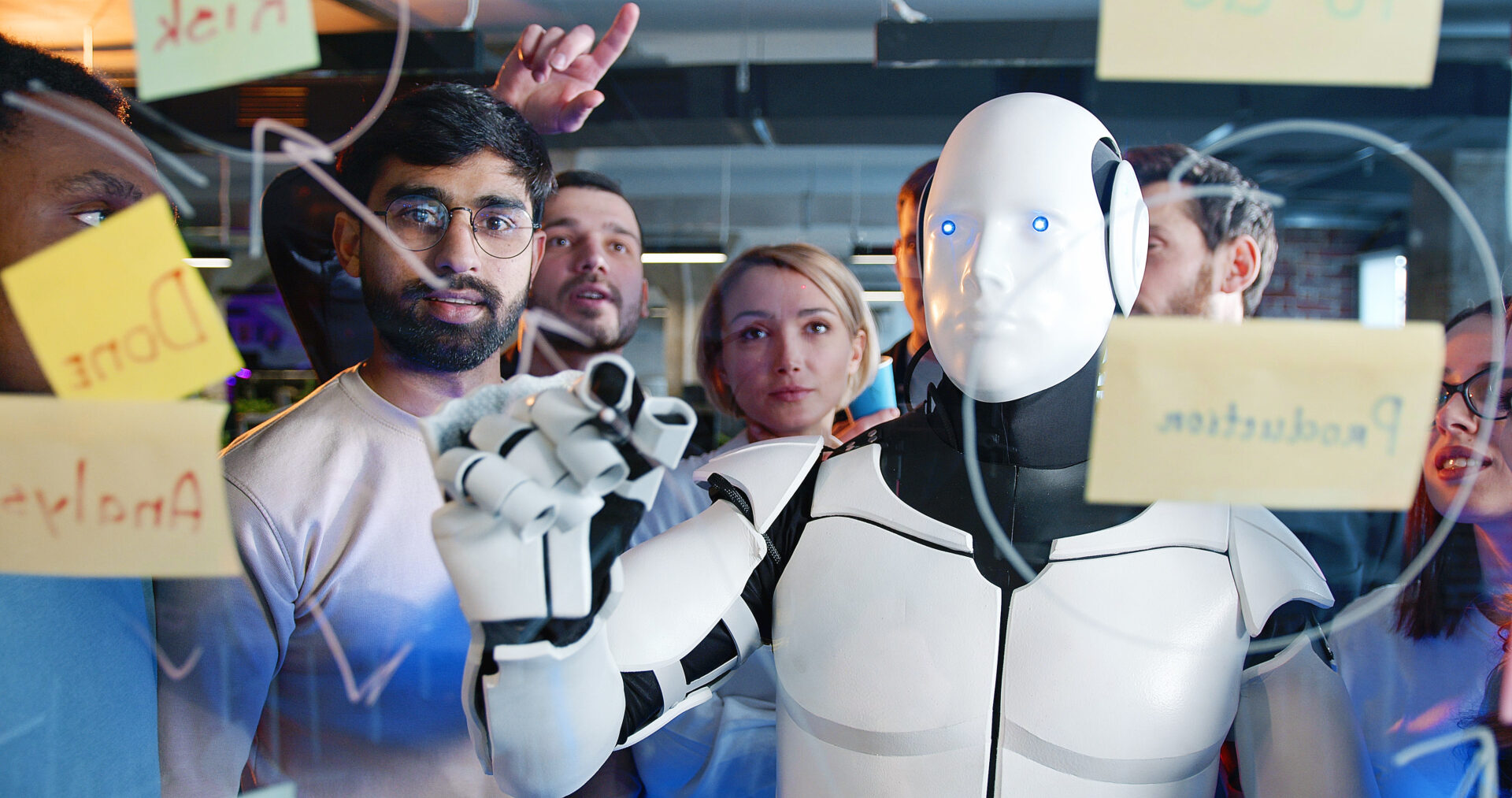

For many business leaders in French-speaking Switzerland, Artificial Intelligence (AI) is still perceived as a complex issue on the IT manager's desk. It's referred to as “software”, a “tool” or, in moments of doubt, a threat to team cohesion. Yet this purely technical view is precisely what's holding back your growth.
What if we changed our perspective?
Imagine if AI wasn't just another piece of software. your next recruitment. A “junior genius”, capable of reading 5,000 pages in a few seconds, synthesizing complex reports and remaining in an even mood 24 hours a day.
The reluctance to integrate AI comes not from a lack of budget, but from a management challenge. You don't deploy AI, you board it. You don't install it, you give it a mission.
Discover how to transform this technological “foreign body” into a valuable colleague who, far from replacing your teams, will enable them to express their full human potential.
Your AI colleague's job profile: a “junior genius”
To successfully integrate an AI, you first need to define his or her responsibilities. As with any new employee, if his or her mission is unclear, he or she will be ineffective.
In tomorrow's organizational chart, AI occupies a hybrid position: that of the’supercharged assistant.
1. Hard skills: power and speed
AI becomes the ideal colleague for all tasks that exhaust the human brain through their repetitiveness:
- Instant synthesis : it can summarize the key points of ten Zoom meetings or annual reports in a matter of seconds.
- Data analysis (without fatigue bias) : it spots trends in your Excel files that the human eye would only see after days of analysis.
- Creative support : it combats blank-page syndrome with presentation structures and e-mail drafts.
2. What it can't do (the human bastion)
This is where the entrepreneur needs to be reassured: AI is not a leader.
- She has no intuition: it predicts the next word, not the market with political finesse.
- She has no empathy: she can write an apologetic message, but she won't know feel a customer's irritation at a business lunch.
- She lacks critical thinking skills: without human supervision, it can assert untruths with total aplomb.
3. The “Centaur vs Cyborg” concept”
In the world of research (particularly that of’Ethan Mollick at Wharton), we can distinguish two types of collaboration with this new colleague:
- Le Centaure: human and AI work separately on different tasks. The human delegates the “calculation” part and keeps the “strategy” part.
- Cyborg: human and AI are totally intertwined. The human writes a sentence, the AI finishes it, the human corrects.
➡️ The challenge for you as a manager : determine which form of collaboration will best serve your business objectives.

Why your employees need it (even if they're afraid)
One of the biggest leadership mistakes is thinking that if you don't provide your teams with AI, they won't use it. In reality, the need for productivity is such that your employees are probably already using it, but in the background.
1. The danger of Shadow AI
This is technological ghosting. Since the company doesn't offer an official framework, employees use free versions of off-the-shelf tools on their personal accounts.
⚠️ The risk to your business : your confidential data (accounting, customer files, industrial secrets) are sent to external servers to drive public models, without any legal protection.
By providing an official and secure “IA colleague”, you are not only modernizing, but also regain control of your information assets.
2. Freeing humans from “robotic” tasks”
We often ask brilliant humans to behave like robots: sorting lines, copying and pasting data, reformatting reports. This is where disengagement comes in.
- AI takes on “monkey work”: she takes care of structure and sorting.
- Humans retain the “added value”: it takes care of interpretation, nuance and decision.
In 2026, talent won't stay with a company that forces them to work the “old way”. AI is no longer a luxury, it's a retention argument.
READ : The role of emotional leadership in digital transformation
How do you manage this new “AI colleague”?
Integrating AI requires new managerial skills. You don't “click” on AI, you direct it.
1. Learn to delegate (the prompting)
Managing an AI is like delegating a task to a trainee who is extremely fast but totally devoid of common sense. If your instructions are vague, the result will be mediocre.
- The golden rule: Context + Task + Format. The more precise you are, the better the “AI colleague” performs.
2. Human-in-the-loop supervision
AI must never have the last word. It prepares, it suggests, it roughs it up. But it's the human who validates.
- The winning model: the AI proposes 3 options, the human chooses the best and refines it. It's a combination of brute force calculation and fine judgment.
Emotional and financial ROI
Beyond time savings (often estimated at between 20% and 40% on administrative tasks), the real gain is strategic. What would your teams do if they suddenly had one free day a week?
- More time with customers?
- More time for product innovation?
- Less stress and burn-out?
AI doesn't necessarily reduce your payroll. It increases typing capacity of your current team without increasing their fatigue.
READ : 7 reasons for small SMEs to adopt marketing automation
Don't be the last to recruit
Installing AI in your company isn't a question of IT, it's a question of vision. It's about deciding that your people deserve to be assisted by the best digital tools, so that they can focus on what makes them human: creativity, empathy and strategy.
Don't be the manager who watches the AI train go by. Become the one who onboards this new colleague to propel everyone else upwards.

✅ Checklist: 5 steps to successful AI onboarding
«You don't deploy an AI, you welcome it as a colleague on the team.»
🧭 STEP 1: THE WORKSTATION AUDIT
Before taking action, identify where the AI's “brute force” will be most useful.
- 🔍 Targeting : identify “time-consuming and repetitive” tasks (sorting, data, summaries).
- 🎯 Objective: define clear missions to avoid technological wandering.
- 🚀 Pilote : choose a test department to prove value (Marketing, HR, Sales).
🛡️ STEP 2: THE TRUST FRAMEWORK
No collaboration without security. Take back control of Shadow AI.
- 🔐 Sovereignty : prefer “Enterprise” versions (data not used for training).
- ⚖️ Compliance : ensure alignment with the LPD Switzerland.
- 📜 Charter : define what is “Public” (authorized) and what is “Confidential” (prohibited).
🎓 STEP 3: TRAINING (SKILL UP)
AI is a “Junior Genius”: you have to learn how to talk to it.
- 🗣️ Prompting : master the art of giving instructions (Context + Task + Format).
- 🧠 Sens Critique : train teams to detect “hallucinations” (errors).
- 🤝 Share : create an internal “Prompt Book” to capitalize on successes.
⚙️ STAGE 4: OPERATIONAL INTEGRATION
AI must become a reflex, not an additional constraint.
- 🔄 Workflow : insert AI into existing tools (Slack, Teams, CRM).
- 🖐️ Human-in-the-loop: the human validates, the human corrects, the human signs.
- 📚 Models : ready-to-use for recurring tasks.
💬 STEP 5: HUMAN FEEDBACK
Successful digital transformation is 100% emotional.
- 📈 Measurement : evaluate the time actually saved and the quality produced.
- 👂 Listen : remove the fears associated with job replacement through transparency.
- 💎 Value : redirect the time freed up to higher value-added tasks.
💡 SMART IMPACT CONSULTING
«Don't look to replace humans, look to augment them. AI manages volume, your people manage value.»
Need professional support? Find out about Smart Impact services, your digital AI agency in French-speaking Switzerland.

Co-founder of Smart Impact.Passionate about the web from the outset, he launched his first project in 2006: an online music magazine that is still running today. With almost 20 years' experience in SEO, a federal diploma in marketing and a solid geek culture, he and his team transform customers' (sometimes vague) ideas into concrete digital projects.