
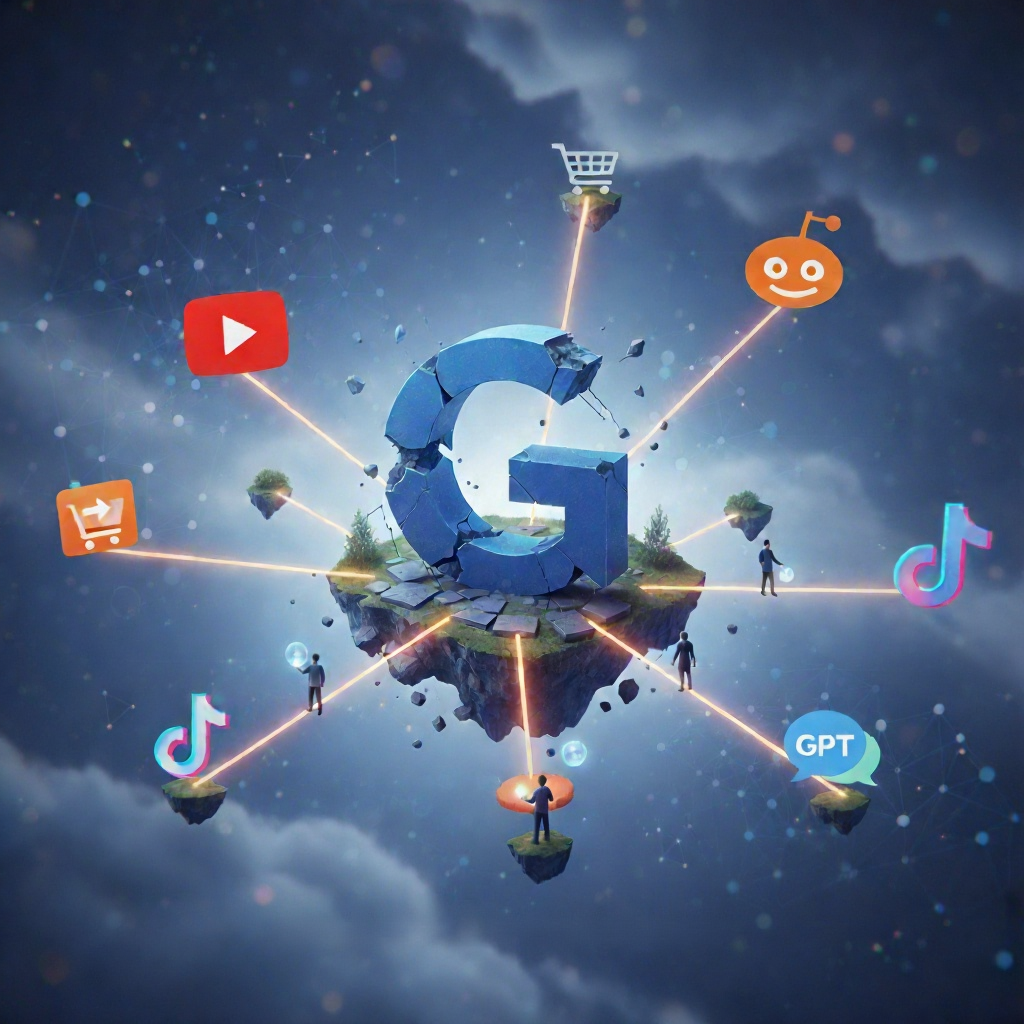

For years, Google was the gateway to the web. To rank well was to be visible. To be visible was to exist. But this model is crumbling. Internet users no longer “search”, they validate. They cross-reference reviews, watch videos, consult ChatGPT, read Reddit, then confirm their impression on Amazon or TikTok. The search engine is no longer the center of the world, but a node among others in an ecosystem of distributed decisions.
Traditional SEO, based on keywords and SERP position, is no longer enough to generate trust. What counts now is not to appear, but to be. credible when the decision is made. In this era, where AIs and communities influence more than engines, search is becoming a social, emotional and algorithmic process all rolled into one.
This change doesn't signal the end of SEO, but its expansion. So we explore this transition, drawing on recent data and concrete examples, to understand how SEO is evolving towards a more comprehensive model: Search Everywhere.
The decline of Google's monopoly
Google remains massive. According to Similarweb, the engine still processes around 13.7 billion daily searches, but this now only represents 27% of all online search activities. The rest is scattered elsewhere: TikTok, Reddit, YouTube, Amazon, ChatGPT. The web has become an archipelago of decisions.
Behaviors confirm this shift. According to a GWI 2025 study, 32% of under-30s first use generative AI to find out about a product before consulting Google. TikTok has become a visual search engine, and Reddit a community validation engine. In reality, conventional SEO captures only a fraction of what's real.
What this means is that brands can no longer rely on a single lever. Ranking well on Google is no longer a guarantee of being chosen. Visibility without credibility is an illusion of presence.
“SEO is no longer a battle for first place, but a strategy for first impressions.”
The new decision path: from research to validation
What used to be a linear buying process has become fragmented. The “I search - I compare - I buy” pattern has exploded. Today, an Internet user discovers a brand on TikTok, checks it out on Reddit, consults Amazon reviews, then asks ChatGPT if it's reliable. All this, often, without ever visiting the official site.
Case studies confirm this. Glossary, a cosmetics brand born on Instagram, saw its organic traffic drop by 18% in 2024. Yet its sales grew thanks to TikTok virality and Reddit discussions mentioning its products. Dyson, has coupled its YouTube tutorials with Reddit threads to validate its technology with technical communities: the result: +28% “comparative” queries on Amazon in three months.
These examples illustrate a new truth: the decision is built up by accumulating micro-proofs. It's not linear, but mosaic-like. Each mention, each review, each recommendation becomes a small signal of trust in a larger cognitive network.
This is where the notion of multi-touch attribution. No single point of contact acts alone. A video arouses desire, an opinion confirms it, an AI query validates it. Performance is no longer measured by a click, but by a sequence of emotions and validations.
Search Everywhere: a model for web decision-making
The concept of Search Everywhere is not about abandoning Google, but about understanding that each platform is a decision engine with its own logic. SEO, in this context, becomes ecosystem work.
TikTok arouses desire: decisions are impulsive, driven by novelty and emotion.
YouTube reassures us: long videos embody expertise and demonstration.
Amazon Trice: reviews are the ultimate social proof.
Reddit valid: authenticity takes precedence over marketing.
ChatGPT and AI synthesize: citing sources deemed reliable and consistent.
Each channel touches a distinct mental moment for the consumer: curiosity, reflection, comparison, confirmation. The question is no longer “where to publish”, but “when to be present”.
This polycentric vision of SEO is driving a profound redefinition of content: produce less, but better. Create to be cited, shared and integrated, not just indexed.
From visibility to validation: a relationship, not an opposition
Opposing visibility and validation would be a mistake. The two feed off each other. Visibility opens the door, but validation lets you in. Efficiency lies in the balance between discovery and trust.
Three complementary levels can be distinguished:
- Discovery Google, TikTok, AI - the initial spark.
- Credibility Reddit, YouTube, reviews - the perceived proof.
- Reinforcement quotations, comparisons, cross-references - consolidation.
Case in point: a startup cited in several Reddit discussions, featured in a Medium article, then mentioned by ChatGPT during a query. In just a few weeks, it builds a validation network that influences both humans and algorithms. AIs pick up on these signals as indicators of authority.
The key is to think in terms of trusted network. Every positive interaction feeds the other platforms. SEO is no longer a strategy of exposure, but a credibility engineering.

Building a strategic presence: from RICE to RACE
The concept of Search Everywhere only makes sense if accompanied by a clear method.
Two frames can complement each other: RICE to prioritize, and RACE to execute.
RICE helps you choose where to invest your energy:
- Reach (TikTok: massive, LinkedIn: targeted)
- Impact What influence does this have on your objectives?
- Confidence Do you have the skills to succeed?
- Ease how easy is it to do?
Once the channels have been selected, RACE deployment structure :
| Step | Objective | A concrete example |
|---|---|---|
| Reach | Choosing the right channels | YouTube + Reddit for a B2B brand |
| Act | Creating decision-making content | Testimonials, case studies, demonstrations |
| Convert | Strengthening social proof | Customer reviews, AI quotes, comparative articles |
| Engage | Maintaining confidence | Newsletter, FAQ, community events |
This dual approach avoids dispersion. An SME can concentrate 80% of its efforts on two key platforms and generate more conversions than by trying to be everywhere at once. Consistency takes precedence over omnipresence.
AI, trust and the future of SEO
The search engine is no longer an interface, it's a network of conversational AIs. ChatGPT, Perplexity, Gemini and Copilot are already shaping the answers visible to millions of users. And these AIs don't display pages: they select brands.
Their logic is based on consistency and quotation. A brand that is frequently mentioned, semantically consistent and well-linked to other reliable sources, is more likely to appear in generative responses. This is what some are already calling the “GEO” (Generative Engine Optimization).
Optimizing for AI means :
- Produce clear, structured content, free of semantic ambiguity.
- Be quoted on recognized platforms (media, forums, studies).
- Reinforce cross-trust signals (reviews, backlinks, social mentions).
Authority signals don't disappear, they just change form. AI isn't looking for backlinks, it's looking for consensus evidence. A brand quoted on Reddit, featured on YouTube and mentioned by specialized blogs will naturally be favored by language models.
Next indicators to watch :
- Citation frequency in generative AIs.
- Presence in Reddit discussions and genuine reviews.
- Coverage by specialized media and expert sources.
In the long term, the strongest brands will be those that have succeeded in becoming interconnected trust references - visible in searches, but above all selected in conversations.
To be chosen rather than seen
SEO isn't dying, it's expanding. Google is no longer the sole judge, but one player among many in a market of trust. Performance is no longer measured by traffic, but by cumulative credibility.
The future of SEO rests on three pillars:
- Coherence a unified message across platforms.
- Targeted presence To be where the decision is made, not everywhere.
- Distributed validation Multiply independent proof points.
The change is already underway. Brands that adapt early will gain organic visibility in AI engines, mentions in discussions and spontaneous citations in generated content. Those that remain fixed on Google will see their traffic stagnate, even with a good ranking.
In 2026, the real question is no longer “how to be found”, but “how to be chosen”. And the answer lies not so much in the algorithms as in the the confidence you inspire.
SEO is no longer an art of position. It's an art of conviction.

Co-founder of Smart Impact.Passionate about the web from the outset, he launched his first project in 2006: an online music magazine that is still running today. With almost 20 years' experience in SEO, a federal diploma in marketing and a solid geek culture, he and his team transform customers' (sometimes vague) ideas into concrete digital projects.