
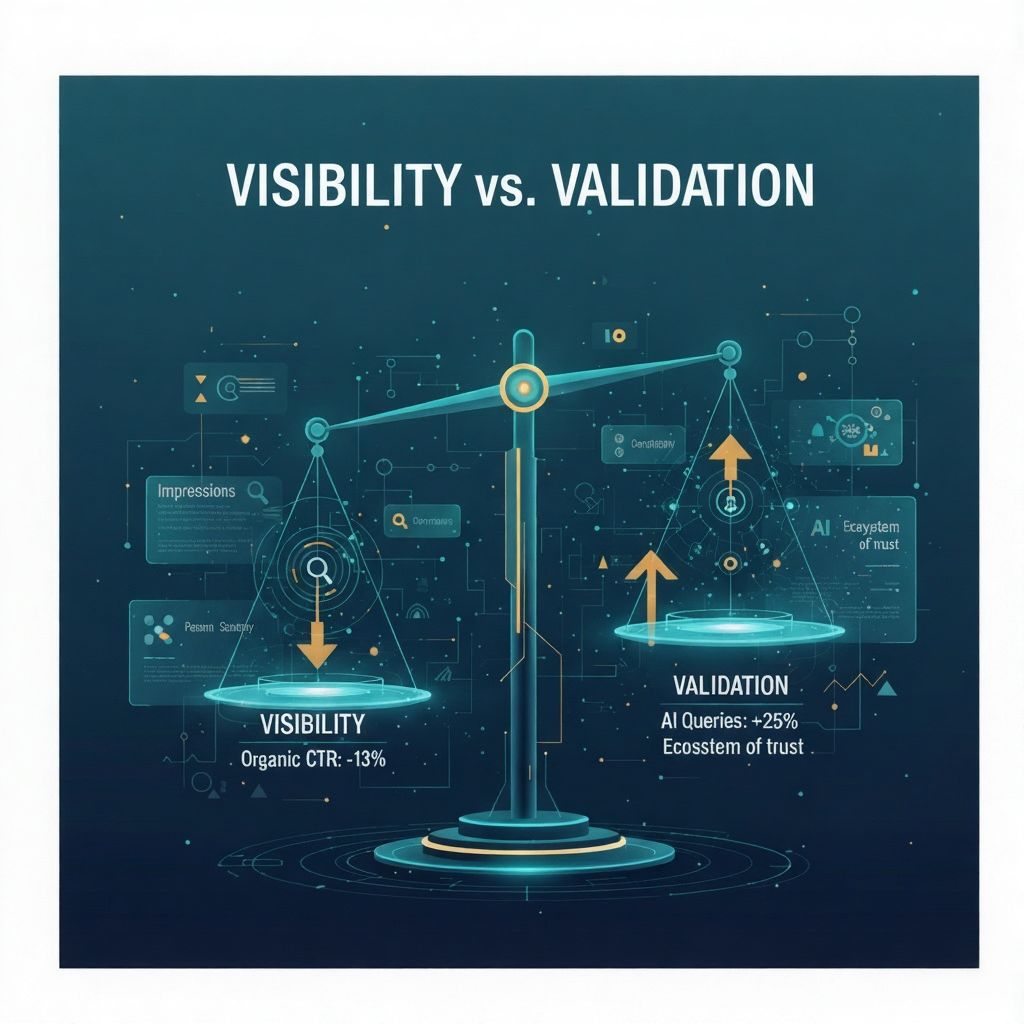

SEO is no longer a simple battle of keywords. In 2026, it's a silent battle between visibility and validation. Being seen is no longer enough. In a world where ChatGPT, Perplexity and Google Gemini respond before the user even clicks, the real question becomes: is your brand worth quoting, recommending or including in the response?
Recent data from SparkToro and Ahrefs confirm the mutation: the organic click rate on Google has dropped by 13 % in one year, while AI engines are capturing more than 25 % of exploratory queries. SEO is no longer just a ranking tool, it has become a trusted ecosystem.
Here are the 7 levers that will redefine SEO in 2026, and how to activate them without falling into the automatisms of a bygone era.
1. Indexing: existing in a web filtered by AIs
Before you can be classified, you have to exist. However, according to Ahrefs (2023), between 12 and 15 % of crawled pages are never indexed. In other words: one page in eight that you publish has no chance of being seen, either by Google or by the AIs.
The causes are often technical: files robots.txt too restrictive, tags noindex forgotten, JavaScript scripts blocking rendering, or internal architecture too deep. A simple rule: no page should be more than three clicks from the home page.
The problem isn't limited to Google. LLMs like ChatGPT or Claude crawl content via public indexes or derived crawlers. If your content isn't indexed, it doesn't exist for these AIs either.
Mini-framework 4I for an express audit:
- Inspect Search Console logs: pages crawled but not indexed
- Insulate structural errors (meta robots, sitemaps)
- Interconnect your strategic pages with contextual links
- Iterate each month to monitor indexation coverage
👉 An unindexed page is a digital ghost. And ghosts don't generate clicks or AI citations.
2. Research intentions: understanding human nuances
The engine doesn't search for words, it interprets intentions. In 2024, 48 % of Google queries included terms expressing a clear intention: “for”, “best”, “near me”, “how”, “advice”.
This evolution is transforming SEO strategy. “Buying a watch” has nothing to do with “which watch to offer”. The former is transactional, the latter exploratory. The pages that win are no longer those that repeat keywords, but those that marry tone, format and purpose research.
Tools such as People Also Ask, AlsoAsked or Glimpse allow us to observe this diversity of intentions. SERP analysis becomes an exercise in anthropology: what types of content dominate? Guides, comparisons, lists, forums? The algorithm reveals what humans really want.
Mini-framework MIM :
- Match expected format (guide, video, fact sheet, comparison)
- Intent Decrypt depth (inform, compare, decide)
- Modulate tone (rational, emotional, expert, conversational)
Good SEO doesn't answer a query. It responds to a human intention at the right time.
3. Relevance and information gain: going beyond cloned content
The web is full of clones. Depending on Search Quality Rater Guidelines of Google (2023), the algorithm favours pages that provide a information gain above average. Simply put: if your content says nothing more or better than the top ten results, it has no reason to exist.
Example: a Swiss company in the energy sector revised its article on heat pumps, adding local data, two infographics and a customer case study. Result: +22 % of visibility on “AI Overviews” in three weeks.
SEO no longer rewards quantity, but clarity and uniqueness. A clean, readable, sourced and updated article now outperforms ten AI-generated hollow articles.
Framework CLEAR :
- Contextualize the subject (audience, issues, local context)
- Link reliable sources (studies, statistics, media)
- Enrich with primary data or visuals
- Analyze missing angles in the top 10
- Review quarterly content
In 2026, true SEO is an editorial exercise. It's no longer a hunt for words, but a quest for utility.

4. Thematic authority: building a cognitive footprint
Google no longer ranks pages, it evaluates trust systems. The notion of’thematic authority is based on the coherence of the subjects covered, the depth of the content and the way in which it relates to each other.
According to a study HubSpot 2024, sites with at least three well-structured clusters see an average increase in organic traffic of 42 %. This approach also appeals to AIs: sites with complete thematic coverage are more often cited in ChatGPT or Perplexity.
Example: a health agency creates a hub on “nutrition” with 8 sub-themes and 120 internal links. Result: +60 % of visibility in responses generated by AI.
Framework TACTIC :
- Topic mapping clear
- Architecture logic (hub → pillars → satellite pages)
- Connection intelligent internal
- Transmission authority between pages
- Iteration quarterly
- Consistency editorial
Building a cluster means building a collective digital memory. The denser your universe, the more algorithmic your credibility.
5. Backlinks: from popularity to algorithmic relevance
The backlink is still a fundamental signal. But its nature has changed. In 2024, 63 % of backlinks bring no measurable traffic or authority (Ahrefs). The era of link farms is over. What counts now is contextual relevance and the ability to feed AIs.
LLM feeders - those sites whose data feeds ChatGPT, Bard or Perplexity - are becoming strategic. Being quoted on Wikipedia, Stack Overflow or even Reddit creates a hybrid exposure effect: human + machine.
An American B2B brand gained 19 % branded queries after five citations in ChatGPT (correlated via Google Trends). This is no longer backlinking, it's cross-system SEO.
Framework PREP :
- Relevance semantic context
- Reputation source site
- Balance between dofollow and nofollow links
- Propagation via AI or editorial platforms
A link is no longer a vote. It's a learning vector for search engines. Good links tell the web something about you.
6. Domain strength: composable SEO capital
A domain has no innate strength. It accumulates capital over time, with every piece of content published, every link received, every brand mention. This capital is built up slowly, like a company's reputation.
Semrush (2024) showed that domains publishing at least one piece of content per week had 27 % more SEO stability. Conversely, a B2B site that remained inactive for six months lost 40 % of visibility in AI Overviews despite a stable link profile.
Framework PULSE :
- Publish on a regular basis
- Standardize technical structure (speed, metadata, tags)
- Linker strategically in-house
- Support brand signals (mentions, reviews, awareness)
- Evaluate quarterly trends
SEO is no longer a sprint. It's a portfolio of digital assets. And every piece of published content is a visibility dividend.
7. Brand signals: validation beyond the click
According to SparkToro (2024), 38 % of searches now include a brand. This means that brand awareness is becoming an indirect ranking criterion: Google favors entities that are known, cited and trusted.
Example: a Swiss SME active in the construction industry combined an optimized Google Business profile with a regular presence on LinkedIn. In three months, it gained +18 % in Google's AI Overview responses.
Framework BRAND :
- Build trust gathering opinions, humanizing the brand
- Reinforce coherence unified identity across all channels
- Activate visibility PR, partnerships, trade media
- Nurture commitment interacting with communities
- Differentiate perception a unique tone, posture and voice
Brand signals are the compass of the new algorithm: they measure trust, not frequency.
Finally, post-IA SEO, between visibility, validation and verification
SEO is no longer a mechanic. It's an ecosystem of trust. Raw visibility: impressions, clicks, positions are no longer enough. What counts is validation To be cited, recognized and taken up by engines, whether human or artificial.
The future of SEO is based on a three-dimensional model: V3 Index.
- Visibility rankings, impressions, organic clicks
- Validation IA citations, brand mentions, editorial backlinks
- Verification engagement, conversions, human signals
In 2026, optimizing a site means orchestrating these three dynamics. The question is no longer “How to appear?”, but “Why deserve to be featured?”.”

Co-founder of Smart Impact.Passionate about the web from the outset, he launched his first project in 2006: an online music magazine that is still running today. With almost 20 years' experience in SEO, a federal diploma in marketing and a solid geek culture, he and his team transform customers' (sometimes vague) ideas into concrete digital projects.