

Everyone wants more visitors.
Unfortunately, very few ask what happens to these visitors once they arrive.
A site can have hundreds of clicks a day... and zero customers at the end of the month.
Not because the offer is bad. Not because the market is saturated.
But simply because there is no no customer path. Just a stream of attention lost in a labyrinth with no way out.
An acquisition tunnel is not a buzzword. It's a structure. A path. A guide that transforms a stranger into a prospect, then into a customer.
A quick vocabulary check (to keep you on track)
This article is about tunnels.
Sometimes a funnel.
Sometimes even both. And that can be confusing.
The word "funnel" comes from the English language. It means funnel.
This is the term used in most marketing tools, as it illustrates a simple model:
a large number of people enter at the top... and only a few emerge at the end.
This model reflects a journey: a lot of curiosity at the start, few concrete decisions at the end.
In French, the word "tunnel is often preferred.
It evokes less the idea of a sorting funnel, and more that of a waymarked pathstep-by-step guide.
For this reason, several expressions coexist in professional vocabulary:
- acquisition tunnel the journey that turns a stranger into a prospect
- sales tunnel the commercial extension for final conversion
- funnel marketing the overall structure that encompasses all stages
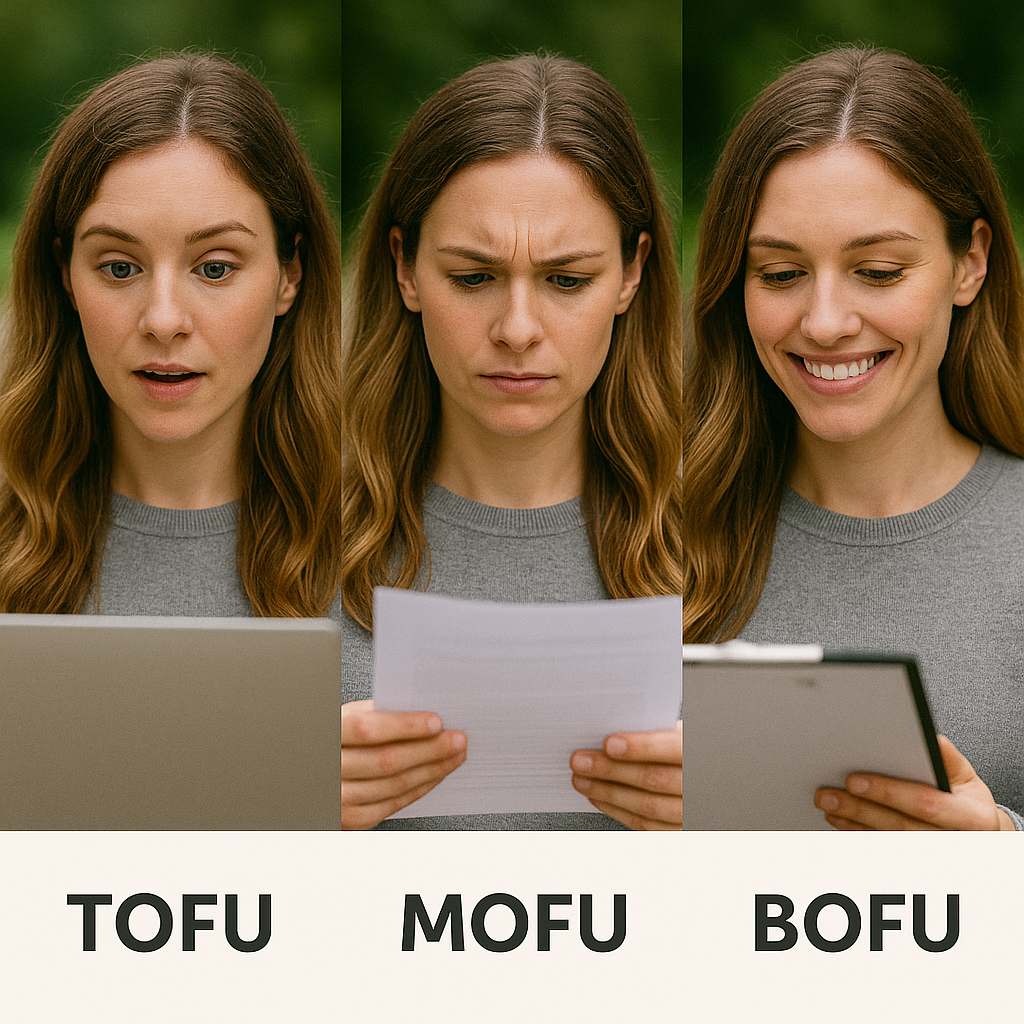
And in this lexicon, we regularly come across three acronyms: TOFU, MOFU and BOFU.
Anglo-Saxon acronyms that are useful to understand when reading an article, report or marketing tool.
TOFU means Top of the Funnel - the top of the tunnel.
This is the discovery phase. The aim is to attract attention, bring out a problem or an initial awareness.
MOFU means Middle of the Funnel - the middle of the course.
Here, the prospect begins to take a more serious interest in a solution. They're comparing and inquiring. This is the time to establish a relationship, to nurture the link.
BOFU means Bottom of the Funnel - the bottom of the tunnel.
This is the decision phase. This is when we propose an exchange, a support, an offer. The moment of commercial truth.
Why this concept is often misunderstood
As soon as you mention the word "tunnel", you can feel people's eyes tense up.
Some associate it with an aggressive marketing technique. Others think it's a trick reserved for American startups or training vendors.
In fact, the tunnel is nothing more than a logical path.
A sequence of steps designed to answer a simple question:
How do you accompany someone from their first visit right through to the decision to buy?
Most sites don't have tunnels.
They have pages. Articles. Buttons. But nothing to tie it all together.
Result:
- unsuccessful visits,
- poorly qualified leads,
- marketing budgets that don't pay off.
The 3 main stages of a true digital tunnel
A good tunnel has a clear dynamic:
attract → convert → convince.

Attract (top of tunnel - TOFU)
This is where it all begins.
Someone has to find out that the company exists. Someone has to say, "That's interesting".
Channels to attract :
- search engines (SEO),
- advertising (SEA),
- social networks,
- shared content.
So be careful: at this stage, the person is not yet looking to buy. They're getting information, exploring.
Example: a blog article entitled "What rights do I have after being made redundant?" or a LinkedIn post on a classic tax error.
The aim here is not to sell. It's about create a first point of contact.
Convert (middle of tunnel - MOFU)
This is where the relationship begins to take shape.
The person showed an interest. They clicked, read, looked.
It's time to propose a suite. Something more engaging.
This is the role of :
- lead magnets (PDF guides, checklists),
- registration forms,
- targeted newsletters,
- demonstrations, free trials.
Example: a lawyer offers a downloadable checklist to help you prepare for a "rupture conventionnelle".
It's not a sale. It's an opportunity to recover a qualified contact.
Convincing (bottom of the tunnel - BOFU)
You're no longer talking to a stranger. You're talking to someone who knows who you are, what you do, and who plans to work with you.
It's time:
- reassure (testimonials, case studies),
- add value (personalized offers),
- guide towards an action (call, quote, make an appointment).
Example: a clear, structured "Why choose us" page, with concrete evidence.
No empty marketing. Concrete.
Test it at home:
Pourquoi mesurer votre tunnel d'acquisition change tout
Beaucoup parlent de trafic. D'engagement. De clics.
Mais très peu savent ce qu'il se passe entre l'arrivée d'un visiteur… et la signature d'un contrat.
Un site peut générer mille visites par semaine et n'en tirer aucun client.
Pas parce qu'il est mal fait. Pas parce que l'offre est mauvaise.
Mais parce que le tunnel fuit. Parce que personne ne mesure ce qui se perd en chemin.
Ce petit calculateur permet de visualiser simplement vos taux de conversion à chaque étape.
Pas pour faire joli. Pour ajuster, corriger, et reprendre le contrôle.
Calculateur de conversion tunnel
What a well-designed tunnel really changes
When everything is aligned, the results change.
No need to double the traffic. Just double the logic.
This little calculator makes it easy to visualize your conversion rates at each stage.
Not to look pretty. To adjust, correct and regain control.
- reduces the bounce rate,
- increases the number of qualified leads,
- lower acquisition costs,
- and gives direction to marketing actions.
It's a frame, not a factory.
And it's often this framework that's missing from "pretty but empty" sites.
The classic mistakes you see everywhere
- Wanting to sell from the first click. Nobody buys at first glance.
- Forget the intermediate steps. We go from "hello" to "pay me".
- Do not segment messages. The same speech for everyone no longer works.
- Leaking everywhere. Too many links, too many distractions, no clear path.
A tunnel shouldn't enclose. It must guide.
Things to remember
A site can be beautiful. An offer can be clear. However, without a tunnel, the prospect is going in circles.
He reads. He clicks. He hesitates. Then he leaves.
The acquisition tunnel is not a hack.
It's a way of taking visitors by the hand, without ever forcing them, and leading them naturally towards conversion.
And often, that little structured path makes all the difference between a site that runs... and one that sells.
📊 Conversion rate studies and benchmarks
- First Page Sage - Conversion benchmarks for SaaS B2B tunnels
A detailed report providing average conversion rates at each stage of the sales funnel for B2B SaaS companies, segmented by marketing channel, industry and company size.
👉 Read the reportfirstpagesage.com - Mosaic - Conversion rate analysis in sales tunnels
A guide to measuring and optimizing conversion rates at each stage of the sales funnel, with tips for identifying friction points and improving overall efficiency.
👉 Read the article

Co-founder of Smart Impact.Passionate about the web from the outset, he launched his first project in 2006: an online music magazine that is still running today. With almost 20 years' experience in SEO, a federal diploma in marketing and a solid geek culture, he and his team transform customers' (sometimes vague) ideas into concrete digital projects.